CV, cover letter, and interview
Preparing a CV suited to the Japanese job market
You will need to prepare a CV in English, following an international format.
The website GaijinPot offers a section for creating a CV. It is fairly straightforward, and you can apply for jobs directly on the site using this CV. You can also download a copy and print it.
Here are a few other websites for creating a clear and professional CV:
English CV: specific expectations in Japan
Although an English CV generally follows the international format, some expectations differ in Japan. As a rule, avoid including a photo on an English CV (photos are mainly used on the Japanese-style CV). Remember to clearly state your visa status (e.g. Working Holiday Visa) and your availability date.
Finally, tailor the content to the sector. Recruiters in tourism and hospitality prioritise availability and hands-on experience, whereas qualified roles (IT, corporate positions, etc.) expect a more experience-focused CV.
The Japanese CV (rirekisho)
The Japanese CV requires a real effort in terms of preparation and writing, and in most cases it is not necessary if you are looking for jobs aimed at foreign nationals and do not speak Japanese.
Only prepare one if the employer specifically asks for it, or if you are applying for a job in a Japanese environment that requires a Japanese proficiency.
Obtaining and completing a rirekisho
The first step is to download a blank CV form (rirekisho). The CV format in Japan is standardised, and all the forms you find online will be very similar.
To fill it in, use an online translator. You should also install a Japanese keyboard on your computer, as you will need to write in Japanese.
Here is a sample CV:
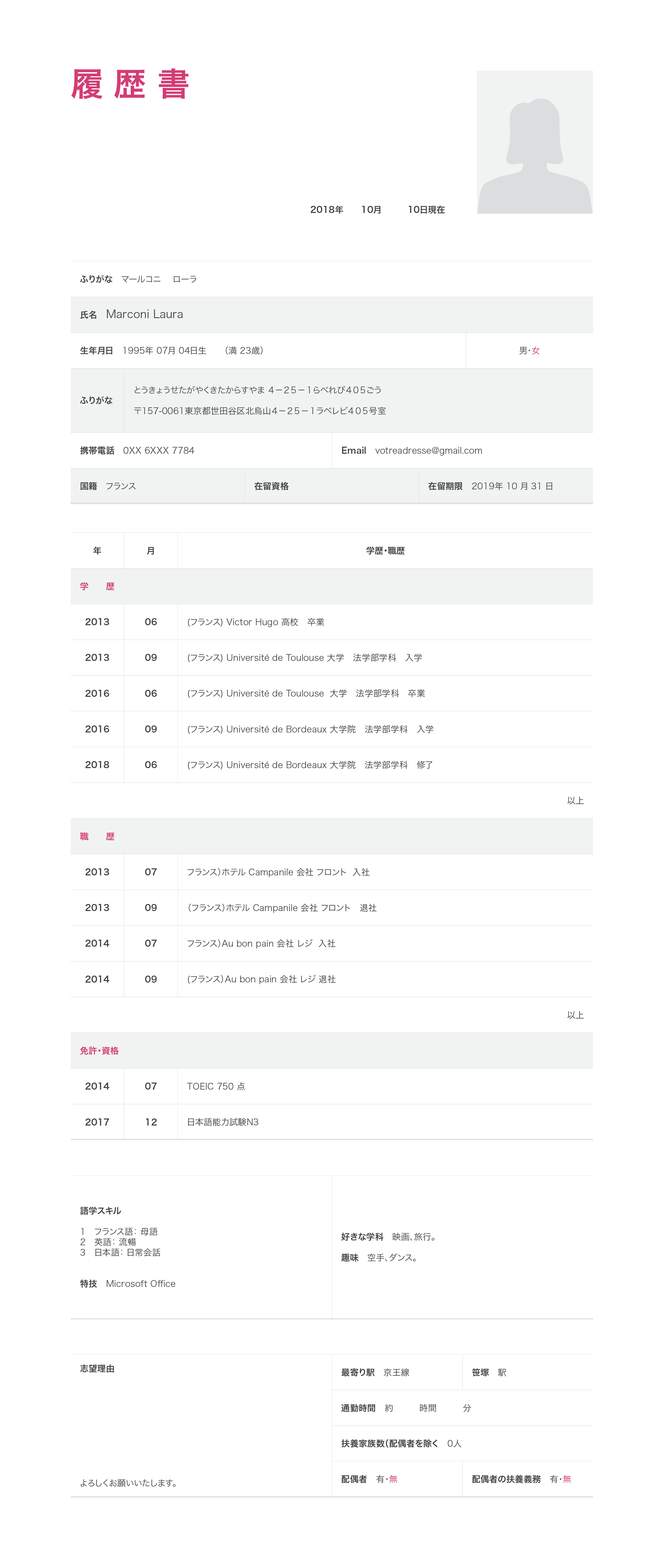
A few useful points to help you complete your rirekisho
- Years in Japan do not follow the Gregorian calendar but the Japanese calendar. For example, 2026 on the Gregorian calendar is Reiwa year 8 (8th year of the Reiwa reign) on the Japanese calendar. Use this tool to do the conversion.
- You must list all significant education and work experience (often starting from middle school or high school).
- At the end of the CV, you can add a few elements about your motivation and the type of position you are seeking, as well as certain preferences (type of role, working hours, commuting time, etc.). This section corresponds in particular to the shibō dōki (志望動機), i.e. your motivation or reason for applying.
- A professional headshot is required. This is discussed below.
The photo must meet specific standards: an ID-style photo taken in a Japanese photo booth (light background, blue or grey depending on the machine), neat attire (suit or, at minimum, a white shirt), hair tied back or neatly styled, and a clean, tidy appearance (closely trimmed beard if applicable, discreet make-up if worn).
In addition to the rirekisho, you may also be asked to provide another document: the shokumukei rekisho, a second resume. This generally applies only to senior or specialised positions requiring fluent Japanese. As a working holiday maker, you are very unlikely to need one.
Cover letter
If you are applying in English, you may be asked for a cover letter, particularly for qualified roles or positions in international companies. However, it is rarely required for most casual jobs in hospitality and catering.
A cover letter in Japanese is not necessary for foreign nationals looking for a baito (casual job). If you see that one is required during the recruitment process, it is often a good indication that the employer expects a good level of Japanese. In that case, it is best to apply only if your Japanese is strong enough.
Job interviews
Japanese norms
Japanese candidates generally attend job interviews wearing a dark suit, white shirt, formal shoes, and with a neat appearance. Physical presentation during a job search is highly codified in Japan. In general, a new recruit is expected to show that they can integrate quickly into the company’s culture and values, while remaining understated in their appearance.
For recent Japanese graduates, the job search often begins around one year before the end of their studies. Large Japanese companies recruit once a year in April. This is why you sometimes see an army of students dressed in black and white heading to interviews, seminars and job fairs throughout the day.
This period is known as shūkatsu. It is a very stressful phase for young Japanese people.
Interviews for baito and qualified positions
Recruiters do not expect foreign nationals to conform in every respect to local recruitment practices.
For casual baito-type jobs, expectations are generally more lenient:
- White shirt, black trousers (jacket and tie depending on the sector)
- No visible piercings or tattoos
- Natural hair colour
- Clean-shaven
- Smart shoes
- Overall clean and tidy appearance
As a general rule, plan to arrive 10 minutes early for the interview. Bring a copy of your CV with you just in case. Remain professional at all times from the moment you enter the company.
According to accounts from many working holiday makers, interviews for baito positions are usually very short (10 to 15 minutes) and straightforward. The recruiter presents the company and the working conditions, then asks you to introduce yourself in Japanese or English (name, nationality, studies, work experience, etc.). You can prepare this introduction in advance. It is also advisable not to mention that you plan to leave Japan soon.
Interviews for office roles in Japanese or international companies
- Highlight your ability to work as part of a team.
- If the interview is in Japanese, use keigo (the polite form of Japanese).
- Do not discuss salary at the first interview.
- Having a business card can be an advantage, especially for office roles (particularly in sales or business-related positions). In Japan, exchanging business cards is very common, and not being able to offer one in return can feel slightly awkward, even if it is usually not a deal-breaker.
- Adapt to local codes. As a foreign national, you will be given a certain degree of leeway for not understanding everything.












 Français
 English








0 comments
{{like.username}}
Loading...
Load more