















France attracts thousands of international students every year to study at one of its many institutions of higher education.
Unless you are a citizen of the European Union, European Economic Area, or Switzerland, you will generally need a student visa to pursue a master’s degree in France.
This article will walk you through the steps of how to obtain a student visa for a master’s program as a resident of a country covered by Études en France.
Contents
- Step 1: Apply to a French university
- Step 2: Complete the visa application form
- Step 3: Make an appointment at the visa centre
- Step 4: Await your student visa
Step 1: Apply to a French university
In order to apply for a student visa, you first need to gain admission into a French university. At most institutions, the school year starts in September.
If you reside in one of the following countries, you’ll need to apply for universities using a platform called Études en France (EEF). It is intended to centralize the application process.
Angola, Algeria, Argentina, Armenia, Azerbaijan, Bahrain, Benin, Bolivia, Brazil, Burkina Faso, Burundi, Cambodia, Cameroon, Canada, Central African Republic, Chad, Chile, China, Colombia, Comoros, Côte d’Ivoire, Democratic Republic of Congo, Djibouti, Dominican Republic, Ecuador, Egypt, Ethiopia, Gabon, Georgia, Ghana, Guinea, Haiti, Hong Kong, India, Indonesia, Iran, Israel, Japan, Jordan, Kenya, Kuwait, Lebanon, Madagascar, Malaysia, Mali, Mauritania, Mauritius, Mexico, Morocco, Myanmar, Nepal, Nigeria, Peru, Qatar, Republic of Congo, Russia, Rwanda, Saudi Arabia, Senegal, Singapore, South Africa, South Korea, Taiwan, Thailand, Togo, Tunisia, Turkey, Ukraine, United Arab Emirates, United Kingdom, United States, Vietnam.
If you reside in a country serviced by EEF
If you reside in a country serviced by EEF, you will need to:
- Create an account on Études en France.
- Find the universities and programs that interest you*. Pay attention to admission requirements. Each program will list out its admission criteria on EEF. This can include bachelor’s degree credentials, French proficiency certificates, and other criteria.
- Apply to your chosen program(s). The application window typically is from October to January/February. If the university asks for your previous transcripts or diplomas and they are not in French, you may need to have them translated by a professional translator.
- Attend an interview, if requested by your university.
- Receive admission (typically in April and May).
- Accept your program of choice.
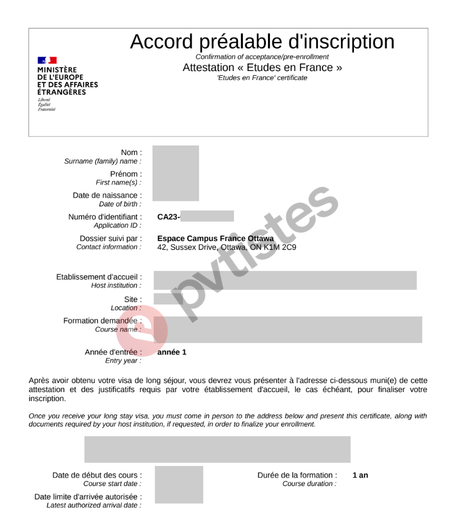
Once you’ve completed these steps, EEF will generate a confirmation document. This document proves that you have been admitted to a French institution. With it, you can proceed to applying for a student visa.
Step 2: Complete the visa application form
Once you have the EEF confirmation document, you can start filling out your visa application form online.
Create an account on France-Visas. Start a new application and complete the form.
At the end of the process, you will need to print out your completed application as well as the registration receipt (image below).
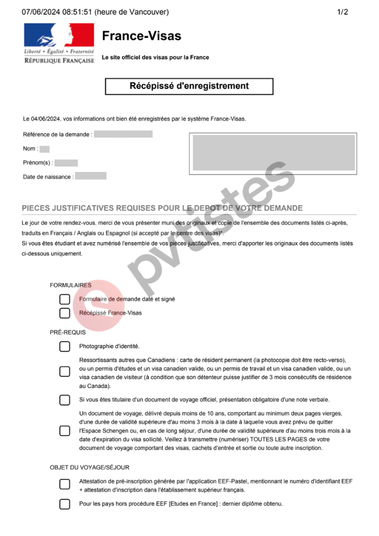
This example in French is from a Canadian, so the exact list may differ slightly for candidates from other countries.
If you are already living in France on a Working Holiday Visa (i.e. sticker in passport), you will need to return to your home country to submit your student visa application.
However, if you are a Canadian citizen with an autorisation provisoire de séjour mention vacances-travail, you may be able to switch to student status from France. Contact your prefecture to confirm.
Step 3: Make an appointment at the visa centre
All applicants must make an in-person appointment. The purpose of this is to submit your application and to have your biometrics (photo and fingerprints) collected.
Depending on your country of residence, your appointment centre may be:
- A VFS centre (e.g., Canada, Australia)
- A consulate or the embassy (e.g., China, India)
- A TLS centre (e.g., Morocco, United States)
- Check for your jurisdiction
You’ll need to make an appointment at your visa centre. Your application submission date should be no earlier than 3 months before your intended arrival in France as a student.
The day of your appointment
On the day of your appointment, make sure to bring:
- Your passport
- Photos (requirements)
- Your completed visa application form and the registration receipt
- Your EEF confirmation document (shown in Step 1)
- Proof of sufficient financial resources
- Proof of accommodation
- Your visa centre appointment confirmation
- Proof of scholarship (if applicable)
- And anything else that may be required of applicants in your situation or with your citizenship.
Step 4: Await your passport and student visa
Processing times vary by visa centre and time of year.
You will get your passport back with the student visa adhered to a page. The visa will typically be valid for 12 months. If your program lasts longer than that, at the end of your first year you can apply for a carte de séjour étudiante at the prefecture where you reside.
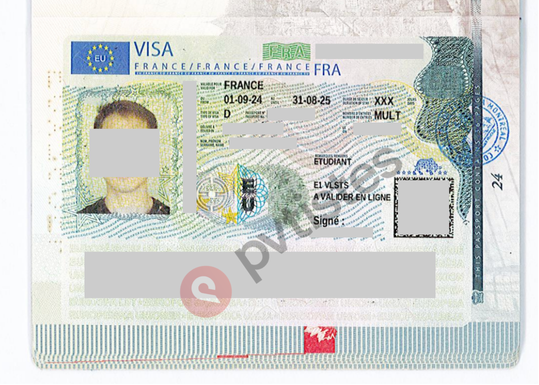
Remember that within three months of entering France on a student visa, you need to validate your visa. This validation is completed online and is mandatory for your stay to remain regular.
Foreign nationals coming to France on student status are eligible for French health care. You can sign up on ameli.fr.
Note, however, that French health insurance does not cover repatriation in case of serious illness or death. As such, you may want to consider purchasing repatriation insurance separately.






0 comments
{{like.username}}
Loading...
Load more