














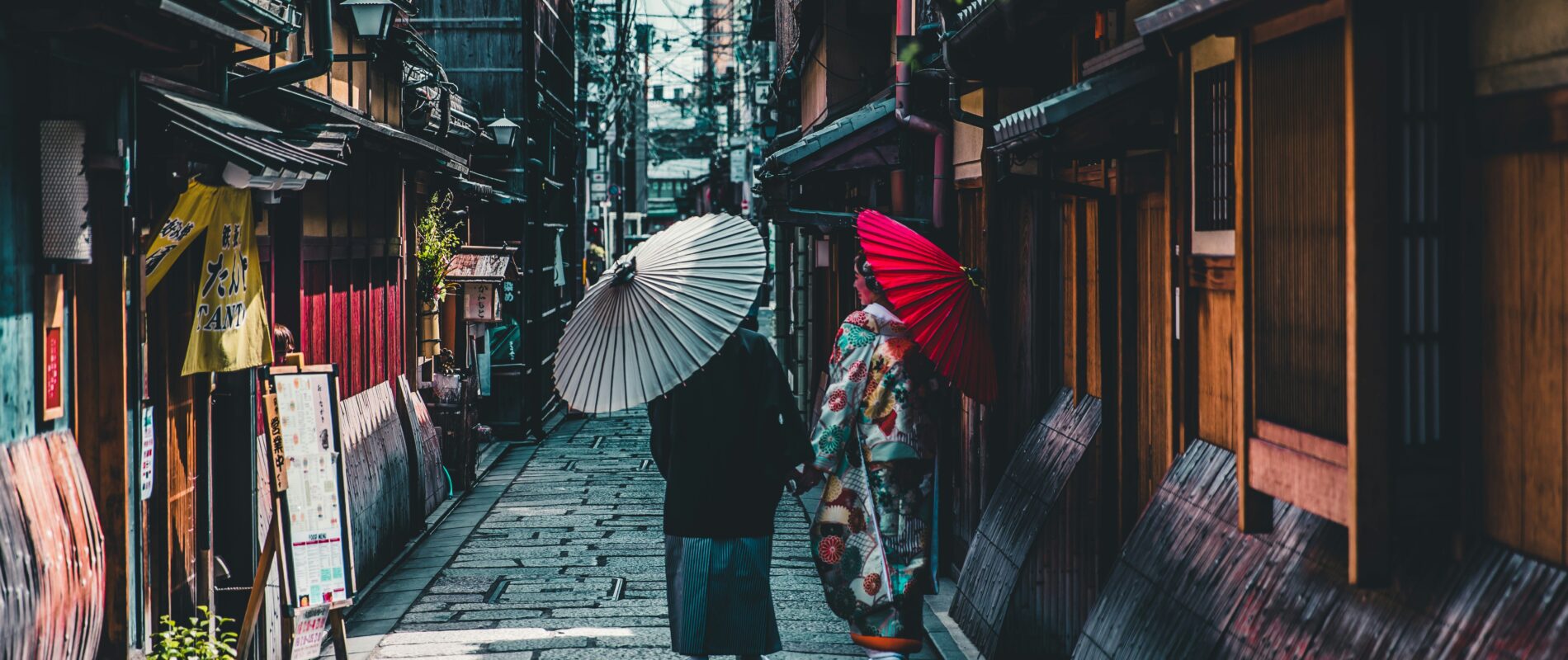
A real example: Enola's experience in Japan
How I found my share house
I found my share house through a friend who’d just moved into a house where a room was about to free up.
Before my friend told me about her share house, I’d already done some searching. A few days before I left for Japan, I went through the different share house websites and sent a few viewing requests. I had a lot of criteria, so I hadn’t shortlisted many houses.
The first one turned me down because I didn’t speak Japanese. Yes, some agencies require you to speak Japanese…
Then I managed to get a viewing at another house for the day after I arrived in Tokyo. In the end, it didn’t work out at all. The share house was quite run-down, poorly equipped and a bit too far out. That’s why it’s a good idea to see the share house and the neighbourhood before you commit.
That’s when my friend told me about her share house. So I got in touch with the agency, did a virtual tour on Google Meet and applied for the room. Once the agency accepted me, I paid the move-in fees (see below) plus the rent. I was due to move in 20 days later (the room wasn’t free before then). In the meantime, I went off travelling around Japan.
All in all, it took a few days to sort everything out.
When I got back, I moved in and signed the contract the same day.
All I had to provide was my passport, my residence card and some personal details. One thing worth knowing: I had to give an emergency contact in Japan who spoke Japanese. Luckily, I knew someone who’d been living in Tokyo for 6 months, and they asked one of their Japanese friends to be my emergency contact. Without that, I’m not really sure what I’d have done.
A lot of share houses ask for an emergency contact in Japan. Sometimes a foreign contact who doesn’t speak Japanese is fine, sometimes it isn’t.
My contract and rent
I paid ¥35,000 in move-in fees: ¥15,000 in admin and cleaning fees (which I didn’t get back) and a ¥20,000 deposit (which I got back). My rent was ¥51,000 plus ¥15,000 in maintenance fees, so ¥66,000 a month in total, which I paid in cash to the agency every month.
I signed a 6-month contract, but I wasn’t locked in: I could leave whenever I wanted, as long as I gave one month’s notice. And if I wanted to stay, I had to renew the contract every 6 months.
The manager of my share house told me that for some very popular share houses, agencies can limit contracts to 6 months with no option to renew.
My share house
I lived in a small share house with 8 residents, or 8 women to be exact, because it was a women-only house. It was a proper house, with the 8 bedrooms spread over 3 floors. We also had a big shared space: living room, dining room and kitchen.
There were two showers, two washbasin areas, two toilets, two washing machines and two dryers. For 8 people, that’s ideal. It’s one shower for every 4 people, so there are no queues at peak times.
My room was 7 m² with a single bed, a wardrobe, a desk, a fridge, air con (very important) and even a little enclosed balcony. Wi-Fi was included in the rent too.
The kitchen was pretty well equipped. There were two rice cookers, a combination oven/microwave, a toaster, a kettle and all the utensils you need to cook.
In the living/dining room there was a TV, a sofa and a fairly big table with 4 chairs.
I’m going into all this detail because not every share house has this much space.
Day-to-day life
My share house was very, very quiet. I didn’t see my housemates much, even though I was home a lot because I worked from home. There was very little, if any, interaction between us. A quick hello when we passed each other, and that was about it. Of the 8 of us, two were French and the others came from various Asian countries. Share houses are often very international, but in my case it was a far cry from the film The Spanish Apartment (L’Auberge espagnole).
I know that in a lot of East Asian countries, people see sharing a home differently from how we do in Europe. Personal space really matters, and you don’t disturb your neighbour or housemate. That has its upside: the house was very quiet and everyone was very respectful. Each of us respected the others’ space, when it came to noise, cleanliness or using the common areas. But it’s a shame there was no cultural exchange between us, because there could have been, and it would have been really interesting.
It’s something to bear in mind before you move in. Share houses aren’t typical flatshares where you become friends and share your lives. In a lot of share houses, there isn’t much interaction, and they’re not necessarily a place to meet people. Of course, every house and every situation is different: some share houses are much livelier than others, and some people manage to socialise a lot in their house.
So the type of share house you choose will make a big difference to your experience. Depending on the neighbourhood, the number of residents, the type of building and the rules, you could end up in a very quiet share house like mine, or a much livelier one.
The rules and how my share house worked
As it was a women-only house, we couldn’t invite men in, even during the day. If it was really necessary, you had to ask permission and let the agency know in advance.
For example, one of my housemates needed her dad’s help to move in, so the agency emailed all the residents to let us know a man would be in the house that day to help his daughter. We were sent all his details by email.
Other visitors (women) were only allowed between 9 am and 10 pm. After that, no visitors. And we had to sign any “guest” in on a board by the front door. The guest also had to wear a “guest” badge.

These rules are really there to make sure the share house stays a quiet, liveable place for everyone. Of course, some houses are less strict than that.
We were on rubbish duty one week a month, in pairs, and the common areas were cleaned once a week. For a house of 8, that was fine.
Lastly, I had to let my agency know whenever I’d be away for more than a day.
My verdict on share house life
I’m someone who likes my own space and likes being alone, in peace and quiet, at home. At first I wasn’t keen on living in a share house, because I was worried I wouldn’t feel comfortable in the house or with the other residents, especially as I work from home and so I’m there a lot.
But in the end, I really enjoyed it.
I think part of it was that my share house was very quiet, and living with other people didn’t stress me out. The house was also really nice, because it was a proper little house. And in the end, knowing I wasn’t living completely alone was quite reassuring. I knew that if I had a problem I could turn to my housemates. Even though we didn’t talk much, they were all nice, and I knew I could ask them for help if I needed to.
So share house life wasn’t as bad as I’d imagined, especially as I was only paying €400 a month, which I think is really reasonable for the quality of the place. The only catch was that I was in a residential neighbourhood. It had everything I needed nearby and good public transport, but it wasn’t right in the heart of one of Tokyo’s lively areas, which I’d have liked. But that’s really a minor point.
The agency that ran my share house is Couverture, and they have lots of other houses in Tokyo. It’s a good, reliable agency and their houses are nice (I know people in their other share houses who are happy with them too).
Here’s their website!
Feel free to share your own share house experiences, tips and recommendations in the comments. They’re always really useful for future working holiday makers.
- Renting a flat in Japan (in French)
- The different types of accommodation on a Japan working holiday (in French)







0 comments
{{like.username}}
Loading...
Load more