













If you’re in the IEC Working Holiday pool (or another category) hoping to receive an invitation to apply, you might be wondering how it works and what the various numbers in the rounds of invitations mean.
This article will explain everything you need to know.
Application overview
Here is the sequence of steps to obtaining an IEC permit to Canada:
- Join the pool.
- Receive an invitation to apply (not guaranteed).
- Accept the invitation to apply.
- Submit your application.
- Receive a letter of introduction.
- Fly to Canada and receive your permit upon arrival.
During the season, invitations to apply are sent out on a weekly basis until there are no more spots. For more details, read the IEC Canada application guide (for all nationalities and categories).
What the numbers mean
Throughout the season, you can track the quota status for your nationality and IEC category on the official website.
You’ll see that there are several numbers, which can be confusing. Let’s take the Working Holiday category for UK citizens as an example.
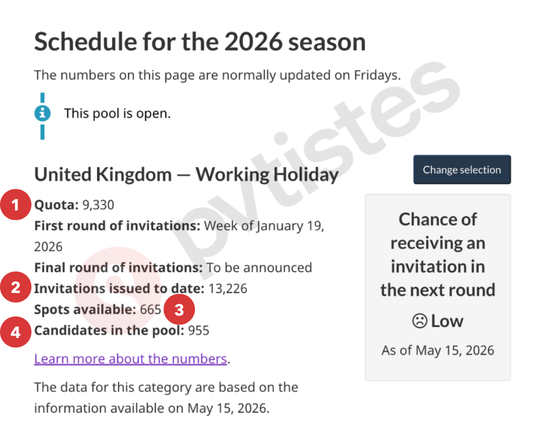
1. Quota
The quota is easy to understand. It is simply the number of work permits that can be issued in the programme year for the specific nationality and IEC category at hand.
In this example, a maximum of 9,330 British citizens can be granted a Working Holiday permit in 2026.
In some years, this number may increase toward the end of the year if, for whatever reason, IEC decides to add extra spots.
2. Invitations issued to date
This number represents how many invitations to apply have been sent out so far.
This is NOT the same thing as the number of permits issued, because remember that:
- People may choose to decline their invitation.
- Some applications get withdrawn or rejected.
Since not all invitations to apply result in a permit granted, it is absolutely possible for this number to be greater than the quota.
3. Spots available
“Spots available” represents the number of permits that are still unambiguously available.
To understand what unambiguously available means, imagine country X has a quota of 1000. If IEC sends out 100 invitations to apply today, then the number of spots unambiguously available will immediately drop to 900. This is because IEC is obligated to reserve spots for those 100 individuals, as it is theoretically possible that all of them will accept their invitation and successfully apply.
As you can guess, in reality, not everyone who is invited to apply will actually claim a spot in the quota. Some of them might:
- Decline the invitation.
- Apply but be rejected.
- Withdraw their application.
Each time this happens, the spot will simply go to someone else. As such, this number is subject to fluctuation depending on actual behaviours of applicants.
To take an extreme example, if none of those 100 invitation recipients end up accepting or applying by the deadline, then the 100 spots will be re-added back to “spots available”, bringing the number back up to 1000. They will then be made available to applicants invited in the next round of invitations.
4. Candidates in the pool
This number captures candidates in the pool who do not currently have an active invitation to apply and are still eligible for IEC. In other words, candidates (maybe like yourself!) hoping to receive an invitation to apply.
The greater the ratio of “spots available” to “candidates in the pool”, the greater your chances are of being selected.
It is best to enter the pool early in the year, as that is when there are the most spots available and the most invitations are sent out.
Also note that the Working Holiday category is by far the most popular (and therefore competitive) IEC category. It is much easier to secure a spot in a different category (if your nationality is eligible).
The day that you exceed the age limit, you will be automatically removed from the IEC pool. This is because you would no longer meet the eligibility requirements of the programme.
You will need to rejoin the pool next year. This is because at the end of every programme year, the pools are emptied.
You have 10 days to accept the invitation. Make sure to follow our application guide to maximise your chances of being approved.
If you are not ready to apply, you can decline the invitation. You will automatically be added back to the pool to be considered for future rounds. Declining does not impact your future odds.
If you don’t accept or decline your invitation within 10 days of receiving it, your profile will be removed from the pool and you will not be considered in future rounds.
If you want, you can create a new profile and add it to the pool again. There is no need to create a new IRCC account, only a new profile.
Yes. If your nationality is eligible for multiple categories, you are allowed to join them all. But note that if you get invited to apply for one category, you will no longer be considered for the other categories.
No. Joining the pool is free. You won’t need to pay any fees until you submit an application (if you receive an invitation to apply).







0 comments
{{like.username}}
Loading...
Load more