














Did you just receive your POE Letter of Introduction following your application for a work or study permit (including IEC: International Experience Canada) in Canada? Congratulations! Now you just need to fly to Canada to activate your permit.
This sounds simple enough, but every year, a number of eager travellers encounter issues at the airport or at the border because they aren’t aware of the technicalities associated with transiting through the US.
In this article, we explain the risks and present more reliable itineraries.
Contents
- Scenario 1: direct flight to final destination in Canada – PREFERRED
- Scenario 2: connecting flight that stops first in another Canadian city – PREFERRED
- Scenario 3: stopping in the US on the way to Canada – NUANCED
- Scenario 4: you are already in Canada
Scenario 1: direct flight to final destination in Canada – PREFERRED
Let’s take the example of a POE Letter of Introduction holder from Australia who plans to start his working holiday in Toronto. If he takes a
- Direct flight from Australia (or anywhere outside of North America) to Toronto,
That is the most reliable way to smoothly activate his IEC permit, upon landing at his final destination of Toronto.
Scenario 2: connecting flight that stops first in another Canadian city – PREFERRED
It is possible that from your departing city, there are no direct flights to your final destination in Canada. In that case, you might need to transit through another Canadian city (or might choose to do so just for pleasure).
Let’s take the same example from before of the POE Letter of Introduction holder from Australia who wants to do a working holiday in Toronto. He might choose to take a:
- Flight from Australia (or anywhere outside of North America) to Toronto, his final destination, with layover in Montreal, or a
- Flight from Australia (or anywhere outside of North America) to Vancouver, vacation in Vancouver for a few days or weeks, then fly to Toronto, his final destination.
Both of these are perfectly viable options.
HOWEVER, it is important to note that you will go through Canadian immigration and have your permit issued at your first point of entry into Canada, that is the first Canadian airport where you land.
As such, if you have a domestic layover in Canada, you should check that the layover is long enough for you to go through immigration and do the necessary procedures relating to your permit.
While it depends on how busy the airport is, 3 hours is generally a safe amount of time (assuming your first flight is not delayed).
Scenario 3: stopping in the US on the way to Canada – NUANCED
If for budgetary or personal reasons you are considering stopping in the US (even for a layover) on the way to Canada, know that there is increased scrutiny: some past IEC participants have reported being denied boarding for their flight to the US for technicalities relating to ESTA and the Visa Waiver Program.
We will explain why below.
Context of ESTA and the Visa Waiver Program
To enter or transit through the US, you generally require authorization to enter the country, even for airport layovers. For travellers from Visa Waiver Program countries, an ESTA is usually sufficient instead of a visa.
Complication
The complication arises in the rules of the Visa Waiver Program.
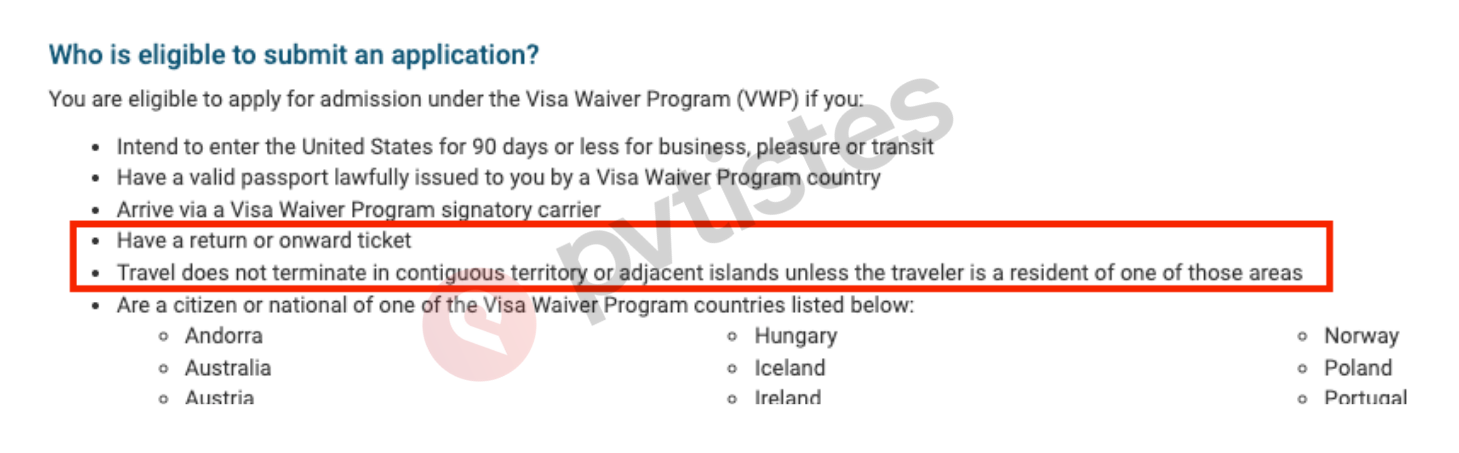
As you can see, in order to benefit from the Visa Waiver Program,
- you should have a return or onward ticket AND
- your travel must not terminate in a contiguous territory (Canada and Mexico) or adjacent islands (Caribbean Islands and Bermuda).
This means that if your final destination is in Canada and you don’t have a return or onward ticket out of North America within 90 days of entering the US, your itinerary may not technically satisfy the requirements of the Visa Waiver Program.
Because of this, some past IEC participants who planned to vacation in the US first or to have a layover in the US before arriving in Canada but did not already have an onward flight out of North America within 90 days of arrival in the US have been
- refused boarding for their flight to the US, or
- been forced to purchase an onward flight on the spot.
No. The POE Letter of Introduction is just formal correspondence indicating that your application was approved. You are not a resident of Canada until you arrive in Canada and activate your permit.
That means at the time of boarding for your flight to the US, this Visa Waiver Program rule may still apply to you.
Yes. Having a layover in a US airport counts as entering the US.
Most travellers who transit through the US encounter no issues. However, a number of travellers do experience further scrutiny for compliance concerns, so in practice it is at the discretion of the airline agent and the immigration agent.
What we recommend
As current and former working holiday makers ourselves, our recommendation is to prioritize scenarios 1 or 2 if possible, as they pose less compliance risk.
If you absolutely must travel through the US, it would reduce risk to have proof of an onward flight that departs from North America within 90 days of your arrival in the US. For example,
- Day 1: land in the US
- Day 10: fly to Canada and activate work or study permit (IEC included)
- Day 80: fly to Iceland
Purchasing a return/onward ticket to depart from North America but not using it may potentially invite future scrutiny in the context of the Visa Waiver Program the next time you enter the US. We do not know what access Americans authorities have on travel history.
Once your permit is activated
Once your work or study permit is activated, travelling between Canada and the US (and transiting through the US) becomes more straightforward because you can demonstrate legal temporary resident worker status in Canada.
Scenario 4: you are already in Canada
If you are already physically in Canada under a different status and need to activate your new permit, in most cases you’ll need to leave and re-enter Canada. But do not flagpole by hopping over the US border.
However, if you are residing in Canada with an IEC permit and trying to activate your second IEC permit, you can request your second IEC permit to be mailed to your address in Canada. That way, you avoid the need to leave and re-enter Canada.






0 comments
{{like.username}}
Loading...
Load more