















As part of your application for a Canadian work permit or study permit, you will receive a letter that goes by a few different names:
- Correspondence letter
- Letter of introduction
- Port of entry letter
Regardless of the name, these terms generally refer to the same document. In this article, we’ll explain what it is and what you need to do with it.
Note: Once your permit application has been approved, you may see two correspondence letters in your IRCC account. They are not duplicates; the two correspondence letters are different. This article refers to the most recent one, as it is the only one that is really important for the next steps of your plans.
What information is included in this letter?
Read this letter carefully, and consider saving a copy of it somewhere.
If you applied for a work permit, the letter will read:
- Your application to work in Canada has been initially approved by Immigration, Refugees and Citizenship Canada. The final decision to issue you a work permit and allow you to enter Canada is made after an examination by an officer in Canada. At that time, an officer will assess if you still meet the requirements of the Immigration and Refugee Protection Act, its Regulations and any other Canadian legislation.
If you applied for a study permit, the letter will read:
- Your application to study in Canada has been approved. A permit authorizing your studies will be issued to you on your arrival to Canada following an examination by an officer of the Canada Border Services Agency, subject to your compliance with the requirements of the Immigration and Refugee Protection Act and its Regulations.
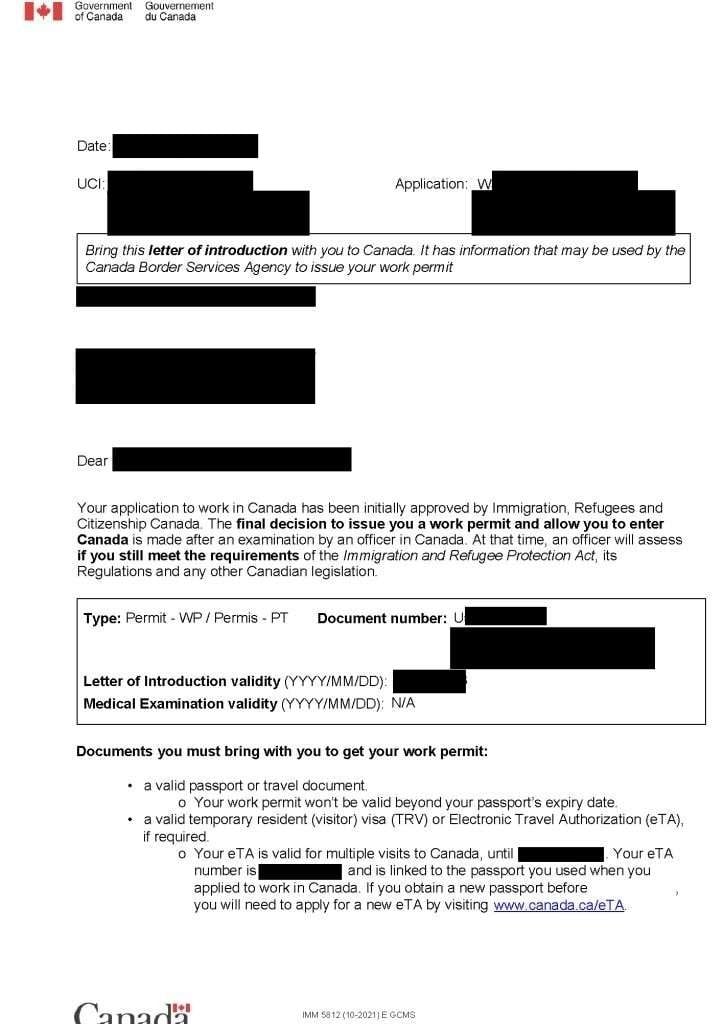
A Point of Entry Letter of Introduction:
- Informs you that your permit application has been approved;
- Constitutes initial approval (more on this below);
- Contains the deadline by which you must enter Canada: if you applied for a Working Holiday permit, you must travel to Canada during the validity period of your letter of introduction. If you applied for an IEC permit, your permit will be issued when you enter Canada with your letter of introduction.
- Specifies that the letter alone does not allow you to enter Canada (see further details at the end of this article);
- Indicates the expiry date of your medical exam (if you underwent one as part of your permit application). If you travel to Canada after it has expired, you will need to undergo another medical exam. Otherwise, you will not be able to accept certain jobs in which public health must be protected, such as childcare and health care. If you did not undergo a medical exam, you will see “N/A” (not applicable).
Additional information for work permits
At this stage, the name of the specific work permit you applied for does not appear on the letter. The general term printed on the letter is WP (work permit), which covers:
- The IEC Working Holiday permit;
- The IEC International Co-op (Internship) permit;
- The IEC Young Professionals permit;
- Other permits granting work authorization.
If you are applying for a closed work permit, your employer’s name and your city of employment will also not be specified on the letter. When you travel to Canada, you should bring your job offer, employment contract, or other documentation containing information about your employment in Canada.
Additional information for study permits
If you have an internship to complete as part of your studies in Canada and you indicated this correctly in your application (this is important!), you will see both:
- SP (Study Permit)
- WP (Work Permit)
When you arrive in Canada, an immigration officer will issue you a study permit and a work permit.
Do I need an eTA to travel to Canada?
The answer depends on your citizenship. You will need either an eTA (electronic travel authorization) or a visitor visa, but not both.
Some countries require an eTA (see list). These are commonly referred to as “visa-exempt countries”. They include Australia, France, Ireland, Japan, New Zealand, South Korea, the United Kingdom, etc.
If you are a citizen of a visa-exempt country, then you will be automatically issued an eTA in your letter of introduction, so there’s no need to separately apply for an eTA or a visitor visa.
If you are not a citizen of a visa-exempt country, then you will be issued a visitor visa rather than an eTA. This will be made clear to you in your letter of invitation.
Confirm using the official tool
If you want to confirm whether the eTA or the visitor visa applies to you, you can use the official tool on Canada’s official website.
What does “This letter does not authorize you to enter, remain or work in Canada” mean?
This statement means that Canada has reviewed your situation and given you initial approval. When you arrive in Canada, you will meet with an officer who will verify that you meet all the requirements. You must be ready to present:
- proof of sufficient funds (for example, a Working Holiday participant must have at least CA$2,500, plus a return ticket or enough additional funds to purchase one later; students must have considerably more savings);
- valid insurance if it is required for holders of your permit category. IEC participants must have valid insurance (we recommend Globe WHV) covering the entire duration of their intended stay. For example, if you are eligible for a two-year Working Holiday permit, you must buy two years of insurance coverage upfront.
What next?
Once you receive your letter of introduction, you can start preparing for your move to Canada with help from the following articles:
- Departure preparation for your working holiday (the full guide)
- Flying to Canada to Activate Your IEC Permit: Step-by-Step Guide
- Travelling to Canada for IEC: Direct Flights vs US Transit
- IEC Working Holiday Permit: the Insurance Requirement Explained
- Working Holiday in Canada: Do These Things During Your First Month
- Top 12 faux pas to avoid when visiting or living in Canada







0 comments
{{like.username}}
Loading...
Load more